
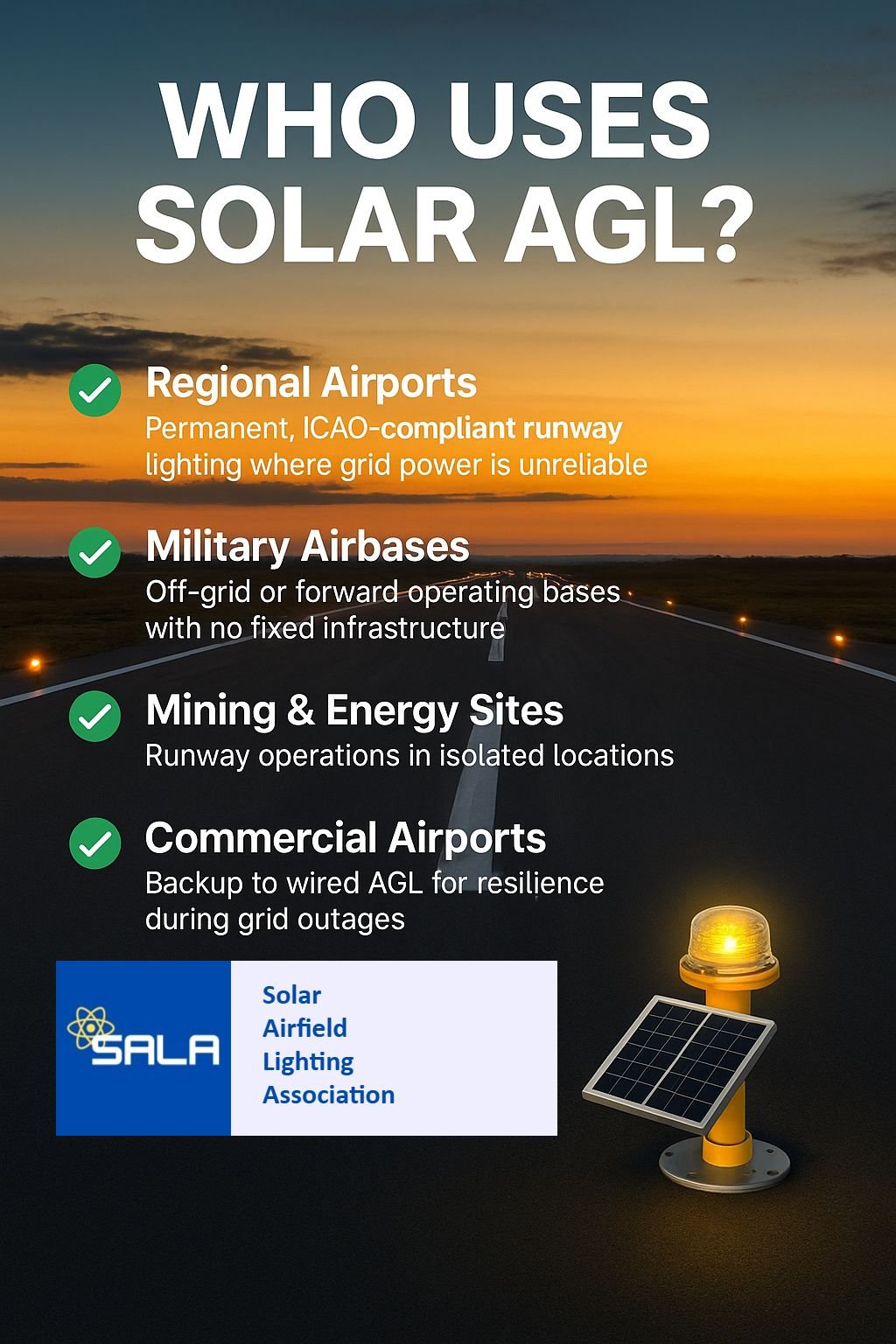
Solar airfield lighting is increasingly used as part of regular airport operations—not just in emergencies. Installations across different sectors demonstrate its role in supporting airfield functionality where grid access is limited or infrastructure costs are high.
✔️ Regional Airports: Permanent, ICAO-compliant runway lighting where grid power is unreliable.
✔️ Military Airbases: Off-grid or forward operating bases with no fixed infrastructure.
✔️ Mining & Energy Sites: Runway operations in isolated locations.
✔️ Commercial Airports: Backup to wired AGL for resilience during grid outages.
In March 2013, Exmouth Aerodrome, a regional airport in Western Australia, installed solar LED lighting (runway edge lights, threshold lights, taxiway blue markers, and wind indicator), replacing a 20‑plus‑year‑old failed mains system. It was recognized by the Australian Airports Association for reliable operations.
A complete solar runway lighting system was implemented in an undisclosed military airbase in North Africa in 2015, illuminating a 3,000 m runway and taxiway. The whole system works without a grid connection, which is important for remote locations.
In 2019, a gold mining airstrip in Ivory Coast deployed permanent solar runway lighting, including PAPI and threshold systems, integrated into a wireless mesh control network. Lights are pilot‑activated via VHF radio or land‑based control units.
Southampton Airport became the first commercial airport in the UK to install solar‑powered LED runway guard lights in 2010, using five autonomous units at runway–taxiway junctions. These lights operate entirely on solar energy, providing cost savings.
These examples reflect the growing role of solar lighting in enhancing airfield operations across diverse environments.
Previous
Previous